


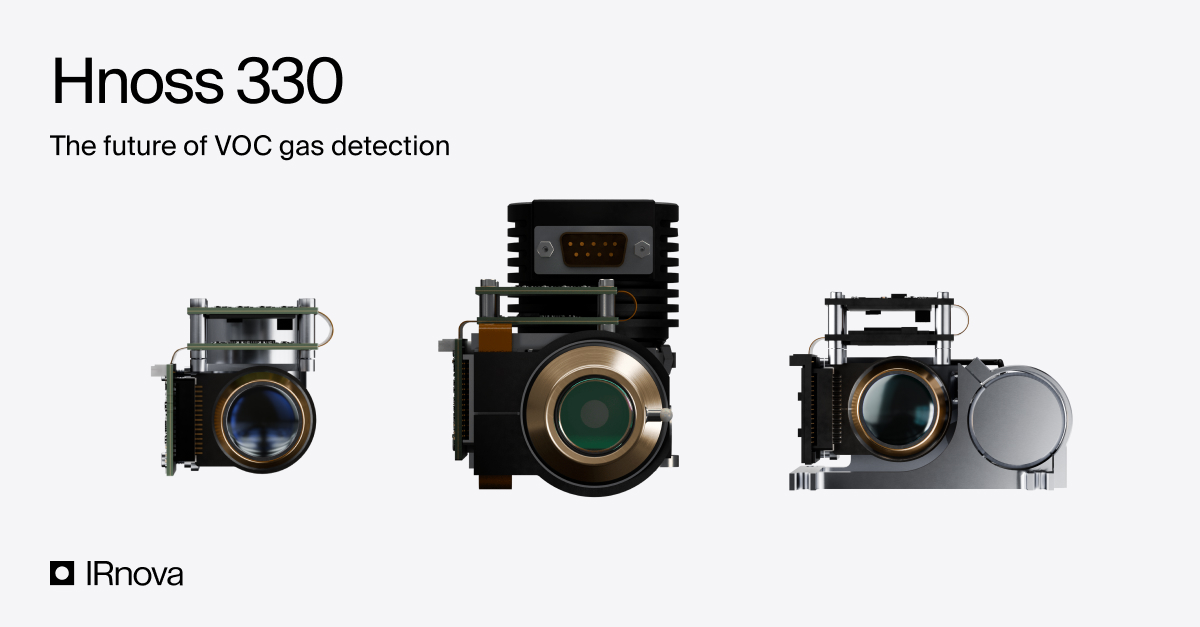
In today's post we explore IRnova's range of OGI detectors for VOC gas detection.
OGI, optical gas imaging, is a technology for seeing gases that are normally invisible to the human eye. Gases emit and absorb only certain wavelenghts of radiation, called absorption peaks. For most gases, those peaks lie mainly in the infrared region and are thus invisible… unless you have an infrared camera. Equipped with an IR filter customized to block everything but a narrow range around these absorption peaks, the OGI detector reveals the gas as a thick smoke against the background.
The Hnoss 330 is our most advanced detector for imaging of VOC gases, volatile organic compounds, a common name for hydrocarbon gases such as methane, propane, butane and many others with an absorption peak around 3.3 µm. In industries such as oil and gas extraction or refineries, detecting gas leaks is cruical for three reasons:
1. It can be a safety hazard, since many VOC gases are explosive
2. Methane is an extremely potent greenhouse gas, 80x more potent than CO2
3. The escaping gas is a pure economical loss to the plant
The EU Methane Regulation, effective from August 4, 2024, requires leak detection and repair (LDAR) practices to be in place to reduce methane emissions, and the US has similar regulation newly implemented under the OOOO rules. OGI is by far the fastest and easiest way to implement LDAR and find leaks, but it requires the right equipment.
For camera manufacturers wishing to compete in this quickly expanding market, we propose the Hnoss 330. It is a highly modern detector with a VGA (640x512) resolution and delivers an unmatched sensitivity as low as 15 mK and an astonishingly sharp image thanks to the underlying T2SL technology. The complete absence of cross-talk between the pixels gives a high MTF, allowing fine detail resolution improving gas detection abilities, and the inherent stability of the material means it offers easy integration and doesn't need to be constantly recalibrated.
It is available in 3 different form factors:
• Rotary SWaP, the very smallest and lightest option
• SL (Split Linear), the shortest and most vibration-free option, especially suitable in drone gimbals
• LLT (Long Life Time), for fixed installations and 24/7 monitoring
Hnoss is also available in versions for detection of CO, CO2 and "see through flames"/furnace inspection.
Read more on the Hnoss 330 product page.